Crochet a calming bedspread from sage green squares with a flower center, open windows and a scalloped shell border.
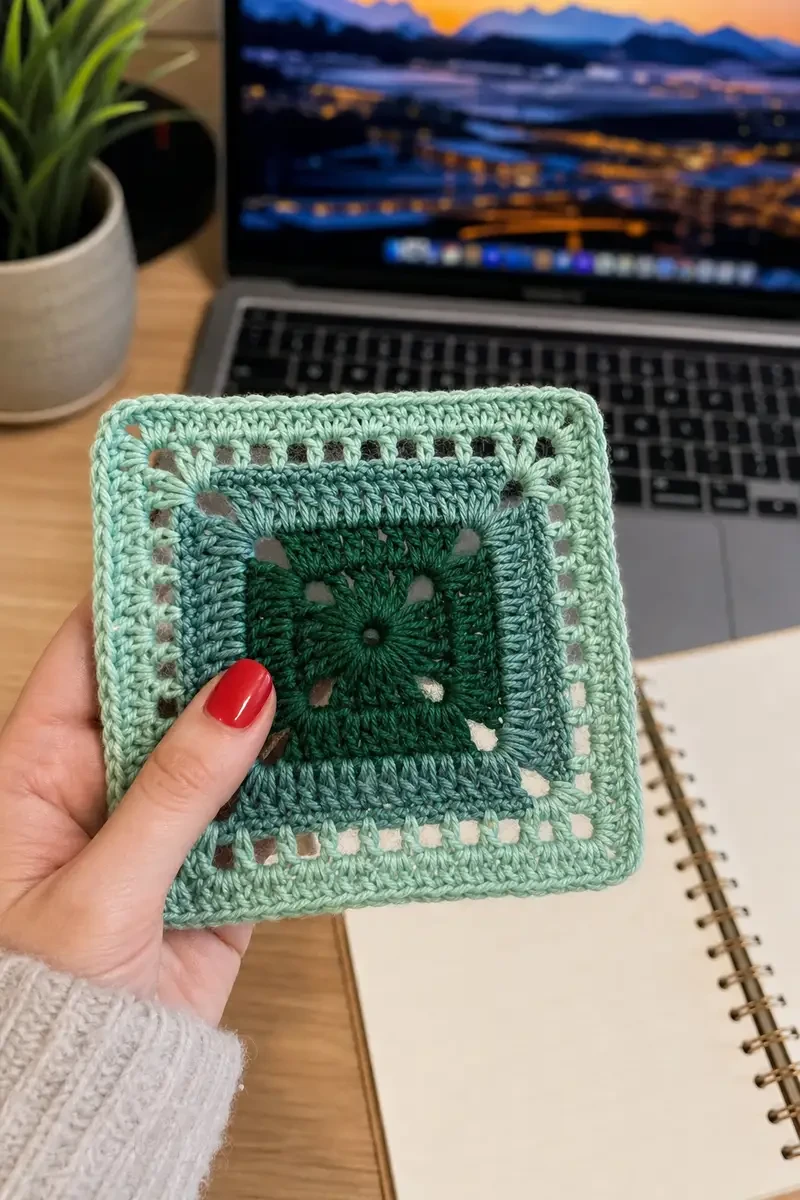
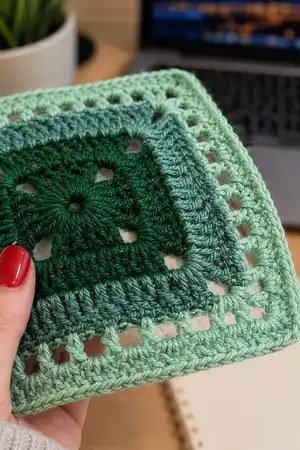
This calming bedspread is made from textured squares in three greens: a deep forest flower center, a mid sage band and a soft mint edge with a row of little open windows. Joined together and finished with a scalloped shell border, they make a luxurious throw or a full bedspread.
Each square is about 24 cm (9.5 in) after blocking. The pattern includes the full square, two ways to join (sewn or join-as-you-go), the border and matching pillow shams.
YarnWorsted weight (#4) in deep forest green, mid sage and soft mint
Notes
Work in joined rounds: close each round with a sl st into the top of the starting chain.
The starting ch 3 counts as a dc and the starting ch 2 counts as an hdc.
From round 6 on, start each round in a corner space: ch 3, (dc, ch 2, 2 dc) in the same space.
Colors: A for rounds 1–3, B for rounds 4–7, C for rounds 8–12 and the border. Fasten off at each color change and join the new color with a sl st.
Make one square first and block it to check your size before making the rest.
Materials
Worsted weight yarn (#4), about 30 g per square. For a full bedspread, about 1500–2500 g in total depending on bed size:
Deep forest green (A, centers): about 600–900 g
Mid sage (B, middle rounds): about 400–700 g
Soft mint (C, outer rounds and border): about 400–700 g
Optional: 50–100 g of a contrast color for pillows
4 mm (G) crochet hook, and a 4.5 mm hook for the border if it pulls tight
Yarn needle, scissors, 8–12 stitch markers, a measuring tape and a row counter
Blocking pins and mats; optional clips to hold squares together and spray starch
Abbreviations (US terms)
ch: chain · sc: single crochet · hdc: half double crochet · dc: double crochet · sl st: slip stitch · sp: space · 3-dc cluster: (yarn over, insert hook, pull up a loop, yarn over, pull through 2 loops) 3 times in the same space, yarn over, pull through all 4 loops · corner: (2 dc, ch 2, 2 dc) in a corner space
Sage Green Square Bedspread: Step by Step
1. Flower center (color A)
2. Turning it square (color B)
3. Windows and outer rounds (color C)
4. How many squares
5. Joining the squares
6. Border (color C)
7. Scalloped shell edge
8. Matching pillow shams (optional, make 2)
Tips for a neat result
Mark the start of each round with a stitch marker so you don't lose count.
Block each square as you finish it, so they are all the same size when you join them.
If you use several dye lots, alternate skeins every few squares to avoid visible bands of color.
Weave the ends into the seams and border rows, at least 2.5 cm (1 in) each, so they don't come loose.
Not sure yet? Make a small lap blanket of 3 x 4 squares first to test your tension and colors.
Use machine-washable yarn if the bedspread will be laundered, and wash a test square first. Dry it flat and store it folded, not hanging, so it doesn't stretch.
About 24 cm (9.5 in) after blocking, with worsted weight yarn and a 4 mm hook.
How many squares do I need for a bedspread?
About 48 for a twin, 72 for a full or queen and 90 for a king, with 24 cm squares. Block one square first and measure it.
How much yarn do I need?
About 30 g per square, plus about 200–300 g for the border. A full or queen bedspread takes about 2000–2500 g in total.
Which joining method is best?
Join-as-you-go gives a flat, seamless front with fewer ends to sew. Sewing is slower but very strong and easy to undo if a square is in the wrong place.
💡 Tick off each round as you go. Your progress isn't saved when you leave the page.
I share verified free crochet patterns to help you find inspiration for your next blanket, amigurumi, hat or handmade gift, and bring them together here so you can skip the endless scrolling and start making.